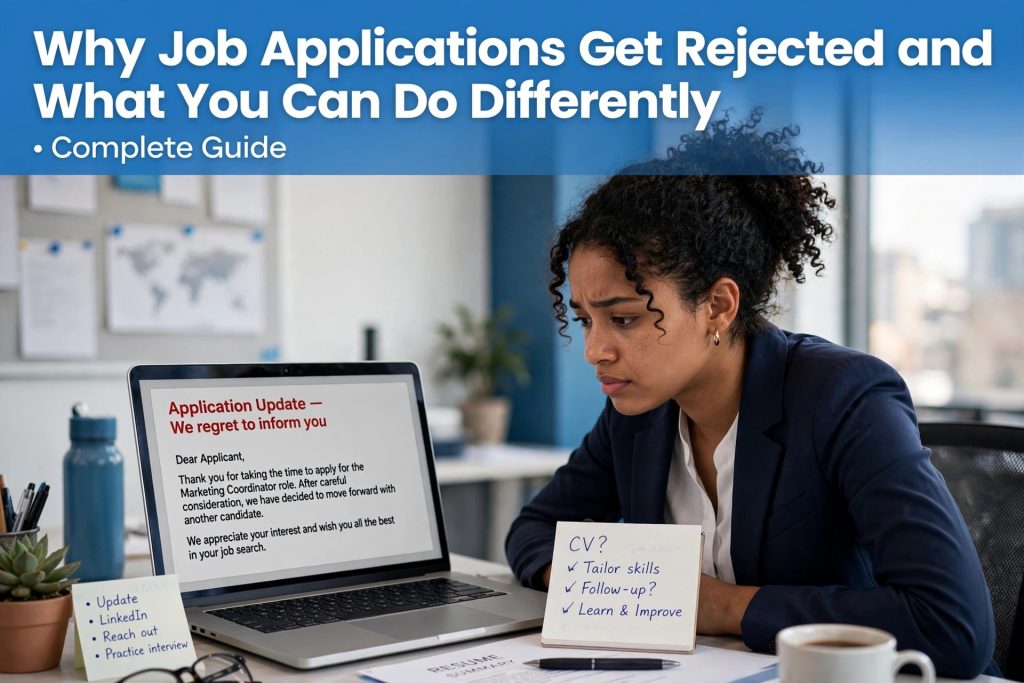
Why Job Applications Get Rejected and What You Can Do Differently
Sending a CV and receiving no response can be frustrating, especially when you have applied for several jobs. Sometimes the problem is not that you are unqualified. Your application may simply fail to show the employer clearly why you should be considered.
A job application is often the first impression an employer gets of you. Small mistakes, missing information or applying for unsuitable positions can reduce your chances of reaching the next stage.
Understanding what can go wrong gives you an opportunity to improve your next application.
1. Your CV Does Not Match the Job
One common mistake is using exactly the same CV for every vacancy.
Different jobs look for different skills. A warehouse position may focus on stock handling and reliability, while an administrative position may place more emphasis on computer and communication skills.
Before applying, read the vacancy carefully and make sure your CV clearly shows the skills and qualifications that are relevant to that particular position.
Do not add skills you do not have just to make your CV look suitable.
2. Important Information Is Missing
An employer should not have to search through your CV to find basic information.
Check that your CV includes:
- Your name and contact details
- Education and qualifications
- Relevant skills
- Previous work experience, if you have any
- Relevant training or certificates
- References where requested
Make sure your phone number and email address are correct. A simple contact-detail mistake can make it difficult for an employer to reach you.
3. You Apply Without Checking the Requirements
Applying for many jobs may feel like the best strategy, but sending applications without checking the requirements can waste your time.
Look at the education, experience, location, licence, skills and other requirements before applying.
If the vacancy specifically requires a qualification or licence that you do not have, changing your CV will not solve the problem.
Focus more attention on positions where your background genuinely matches the advertisement.
4. Your CV Is Difficult to Read
A CV does not need complicated designs to look professional.
If the information is crowded, badly arranged or filled with spelling mistakes, the important details can easily be missed.
Use clear headings and short sections. Keep the information relevant and check your spelling before sending the document.
Your goal is simple: make it easy for someone to understand your background quickly.
5. You Have No Experience and Give Up Too Soon
First-time job seekers often face a difficult situation: employers want experience, but you need your first opportunity to gain it.
If you have no formal employment history, do not leave your CV almost empty.
Include genuine information about your education, skills, volunteer activities, temporary work, community involvement or other experience that demonstrates responsibility.
Never invent employment history. Instead, show what you can genuinely offer.
6. You Ignore the Application Instructions
Some vacancies ask applicants to use a specific application method.
For example, an employer may request a CV through a particular recruitment platform or provide instructions for submitting an application.
Ignoring those instructions can cause your application to be missed.
Read the entire advertisement before applying and follow the employer’s stated process.
7. Your Application Contains Obvious Errors
Small errors can make an application look rushed.
Before pressing send, check:
- The employer’s name
- Job title
- Your contact details
- Spelling
- Dates
- Attachments
- Email address
- Required documents
If you are sending an email application, make sure the attached CV is actually included.
8. You Apply Only When You See the Perfect Job
Waiting for one particular type of job can make your search much longer.
If you are open to different entry-level opportunities, consider positions that match your existing skills while continuing to work towards your preferred career.
For example, an entry-level role can help you develop communication, customer service, computer, teamwork or administrative skills that may become useful when applying for another position later.
A Simple Check Before You Apply
Before submitting your next application, ask yourself five questions:
Does my CV match this vacancy?
Have I checked the minimum requirements?
Are my contact details correct?
Have I followed the application instructions?
Have I checked the CV for errors?
If you can answer yes to all five, your application is at least being submitted carefully and professionally.
Rejection Does Not Always Mean You Are Not Good Enough
A rejected application can feel personal, but employers may receive many applications for one vacancy.
There can also be requirements that are not obvious from a short job advertisement. The important thing is to use rejection as a reason to review your approach rather than sending the exact same application repeatedly.
Improve one part of your job search at a time.
Update your CV. Apply for suitable positions. Follow instructions carefully. Keep learning skills that are useful in the type of work you want.
Final Thoughts
Job searching takes more than sending as many CVs as possible. A better approach is to understand the vacancy, present your genuine skills clearly and make sure your application follows the employer’s instructions.
If your applications are not getting responses, review your CV and application process before assuming that you cannot find work.
For more South African job-search advice and employment opportunities, search sacareer24.